From Chaos to Clarity: Anonymized Case Study of a Failed CDP Implementation We Rescued
Introduction: The Promise and Peril of Customer Data Platforms
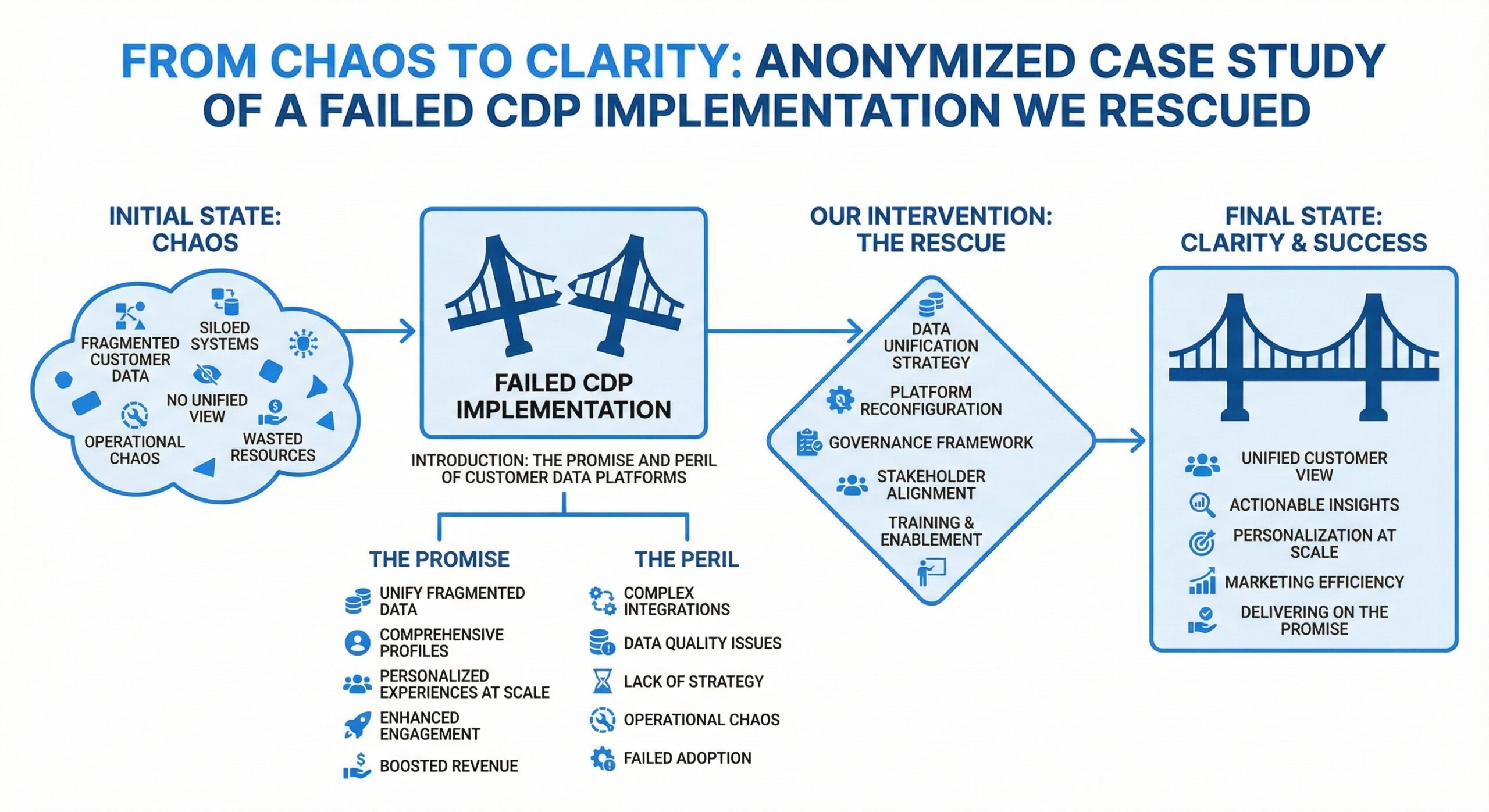
In today’s hyper-competitive digital landscape, businesses are increasingly turning to Customer Data Platforms (CDPs) to unify fragmented customer data, create comprehensive customer profiles, and deliver personalized experiences at scale. The promise of CDPs is compelling: a single, unified view of the customer that drives marketing efficiency, enhances customer engagement, and ultimately boosts revenue. However, the journey to CDP success is fraught with challenges, and many organizations find themselves navigating a path from initial excitement to operational chaos.
This article presents an anonymized case study of a failed CDP implementation that we successfully rescued, transforming it from a costly liability into a strategic asset. By examining the root causes of failure, the rescue strategy we employed, and the lessons learned, we aim to provide valuable insights for organizations embarking on or struggling with their own CDP initiatives.
Customer Data Platforms have emerged as a critical component of modern marketing technology stacks. Unlike traditional data warehouses or data lakes that require significant technical expertise to access and analyze, CDPs are designed to be marketer-friendly, providing accessible, real-time customer data that can be used to power personalized campaigns across multiple channels. According to industry research, organizations that effectively leverage customer data see significant improvements in marketing ROI, customer lifetime value, and overall business performance.
However, the reality for many companies is that CDP implementations fall short of expectations. Studies suggest that a significant percentage of digital transformation initiatives, including CDP deployments, fail to deliver their intended outcomes. The reasons for these failures are multifaceted, ranging from technical challenges to organizational misalignment and unrealistic expectations.
Our case study illustrates how a combination of strategic oversight, technical missteps, and organizational dynamics can derail even the most well-intentioned CDP project. More importantly, it demonstrates that with the right approach, expertise, and commitment, it is possible to rescue a failing CDP implementation and unlock its full potential.
The Anatomy of CDP Failure: Common Pitfalls and Warning Signs
Before diving into our specific case study, it’s essential to understand the common factors that contribute to CDP implementation failures. Recognizing these pitfalls can help organizations avoid them or identify early warning signs that intervention is needed.
1. Lack of Clear Business Objectives
One of the most fundamental reasons for CDP failure is the absence of clear, measurable business objectives. Many organizations approach CDP implementation as a technology-first initiative, focusing on the platform’s capabilities rather than the business problems it should solve. Without a well-defined purpose, the implementation lacks direction, making it difficult to prioritize features, measure success, or gain stakeholder buy-in.
When business objectives are not clearly articulated, CDP projects often become technology exercises rather than strategic initiatives. Teams may spend excessive time and resources on data integration and technical configuration without considering how the platform will drive specific business outcomes. This disconnect between technology and business value can lead to frustration, budget overruns, and ultimately, project abandonment.
2. Inadequate Data Governance and Quality
Data is the lifeblood of any CDP, and poor data governance practices can quickly undermine the platform’s effectiveness. Common data-related issues include inconsistent data formats, duplicate records, incomplete customer profiles, and outdated information. Without robust data governance frameworks, organizations struggle to maintain data accuracy, consistency, and reliability.
Data quality problems often stem from siloed data sources and inconsistent data collection practices across different departments. Marketing, sales, customer service, and e-commerce teams may collect and store customer data in different ways, making it challenging to create a unified view. Additionally, the absence of data ownership and accountability can lead to conflicting priorities and competing interests, further complicating data integration efforts.
3. Organizational Silos and Resistance to Change
CDP implementations require cross-functional collaboration and organizational alignment, but many companies struggle with entrenched silos and resistance to change. Different departments may have their own data systems, processes, and priorities, making it difficult to establish a unified approach to customer data management.
Resistance to change can manifest in various ways, from skepticism about the CDP’s value to reluctance to share data or adopt new processes. Without strong executive sponsorship and change management initiatives, CDP projects can stall or fail to gain traction. The cultural shift required to embrace data-driven decision-making and customer-centricity is often underestimated, leading to implementation challenges and adoption issues.
4. Technical Complexity and Integration Challenges
CDPs are inherently complex systems that must integrate with a wide range of data sources, marketing technologies, and business applications. Technical challenges can arise from incompatible data formats, API limitations, legacy system constraints, and scalability requirements. Organizations may underestimate the technical resources and expertise needed to successfully implement and maintain a CDP.
Integration challenges are particularly acute when dealing with legacy systems that were not designed with modern data integration in mind. Custom development, data transformation, and ongoing maintenance can become significant burdens, diverting resources from strategic initiatives. Additionally, the rapid evolution of marketing technology ecosystems means that CDPs must be flexible and adaptable to accommodate new data sources and use cases.
5. Unrealistic Expectations and Timeline Pressures
Many CDP implementations fail because of unrealistic expectations about what the platform can deliver and how quickly it can be achieved. Organizations may expect immediate ROI or assume that the CDP will automatically solve all their data and marketing challenges. When these expectations are not met, stakeholders become disillusioned, and support for the project wanes.
Timeline pressures can exacerbate these issues, leading to rushed implementations, corners being cut, and inadequate testing. The desire to show quick wins can result in launching the CDP with incomplete data sets, limited functionality, or insufficient training, setting the stage for long-term problems.
Case Study: Rescuing a Failing CDP Implementation
Background: A Promising Start Derailed
Our client, a mid-sized e-commerce retailer operating in the fashion and lifestyle sector, embarked on a CDP implementation journey with high hopes. The company had experienced rapid growth over the previous five years, expanding its product offerings, customer base, and digital presence. However, this growth had also led to increasing complexity in its technology stack and data management practices.
The organization’s marketing team relied on multiple point solutions for email marketing, social media advertising, customer segmentation, and analytics. Customer data was scattered across various systems, including the e-commerce platform, CRM system, email service provider, and third-party analytics tools. This fragmentation made it difficult to create a comprehensive view of customer behavior, personalize marketing messages effectively, or measure campaign performance accurately.
Recognizing these challenges, the company’s leadership approved a significant investment in a leading CDP solution. The initial implementation was led by the IT department, with input from marketing and analytics teams. The project was expected to be completed within six months, with a phased rollout of features and capabilities.
The early stages of the implementation appeared promising. The CDP vendor provided extensive training and support, and the technical team successfully connected several key data sources to the platform. Initial demonstrations showed the potential for creating unified customer profiles and segmenting audiences based on behavioral data. Stakeholders were optimistic about the platform’s ability to transform their marketing operations and drive business growth.
However, as the implementation progressed, warning signs began to emerge. Data quality issues became apparent, with incomplete customer profiles and inconsistent data across sources. Marketing teams struggled to access and use the CDP effectively, citing a steep learning curve and limited functionality for their specific use cases. The promised integration with the company’s email marketing platform encountered technical difficulties, delaying key campaign capabilities.
Despite these challenges, the project continued, with the team working to address issues and refine the implementation. After nine months, the CDP was officially launched, but the results were disappointing. Adoption rates among marketing teams remained low, data accuracy concerns persisted, and the expected improvements in campaign performance failed to materialize. The project was widely perceived as a failure, and discussions began about abandoning the CDP altogether.
The State of Chaos: Assessing the Damage
When we were engaged to assess the situation, we found a CDP implementation in disarray. Our initial evaluation revealed a complex web of technical, organizational, and strategic issues that had contributed to the project’s failure. The platform was technically functional but operationally ineffective, serving as a costly reminder of unfulfilled promises rather than a strategic asset.
Technical Assessment
Our technical review identified several critical issues with the CDP implementation:
- Incomplete Data Integration: While several data sources had been connected to the CDP, key systems were missing or only partially integrated. The company’s mobile app data, customer service interactions, and in-store purchase history were not being captured, resulting in incomplete customer profiles.
- Data Quality Problems: The data flowing into the CDP suffered from significant quality issues, including duplicate records, inconsistent formatting, and missing values. Customer identity resolution was unreliable, with multiple profiles often created for the same individual.
- Poor Data Modeling: The CDP’s data model had been configured without sufficient consideration for the company’s specific business requirements and use cases. Key customer attributes and behavioral events were not properly defined or captured, limiting the platform’s analytical capabilities.
- Integration Bottlenecks: The integration with the email marketing platform remained problematic, with data synchronization delays and formatting issues that prevented effective campaign execution. Other marketing technology integrations were similarly underdeveloped.
- Performance Issues: The CDP was experiencing performance bottlenecks, with slow data processing times and delayed updates to customer profiles. This undermined the platform’s ability to support real-time personalization and timely marketing interventions.
Organizational Assessment
Beyond the technical challenges, we identified significant organizational and cultural barriers to CDP success:
- Lack of Ownership: There was no clear ownership or accountability for the CDP within the organization. The IT department had led the implementation but viewed it as a completed project rather than an ongoing operational responsibility. Marketing teams felt disconnected from the platform and lacked the skills and confidence to use it effectively.
- Limited Cross-Functional Collaboration: The CDP implementation had been primarily an IT initiative, with limited involvement from marketing, analytics, and customer experience teams. This siloed approach had resulted in a platform that did not fully meet the needs of its intended users.
- Insufficient Training and Support: While initial training had been provided, ongoing support and knowledge transfer were lacking. Marketing teams struggled to navigate the CDP’s interface, create segments, and interpret data insights.
- Misaligned Incentives: Different departments had competing priorities and metrics, making it difficult to establish a unified approach to customer data management. The lack of shared goals and incentives hindered collaboration and data sharing.
Strategic Assessment
Our strategic evaluation revealed fundamental issues with the CDP’s purpose and alignment with business objectives:
- Unclear Business Case: The original business case for the CDP had been vague, focusing on generic benefits like “better customer insights” and “improved personalization” without specific, measurable goals. This lack of clarity had made it difficult to prioritize features, measure success, or demonstrate ROI.
- Misaligned Expectations: Stakeholders had unrealistic expectations about what the CDP could deliver and how quickly. The platform was expected to automatically solve complex marketing challenges without the necessary data, processes, or organizational changes.
- Lack of Executive Sponsorship: While the CDP project had initial executive support, ongoing sponsorship and advocacy had waned as challenges emerged and results failed to materialize. This lack of leadership engagement made it difficult to secure additional resources or drive organizational change.
The Rescue Strategy: A Comprehensive Approach
Based on our assessment, we developed a comprehensive rescue strategy designed to address the technical, organizational, and strategic issues that had undermined the CDP implementation. Our approach was built on four pillars: strategic realignment, technical remediation, organizational enablement, and continuous improvement.
Pillar 1: Strategic Realignment
We began by working with the client’s leadership team to redefine the CDP’s purpose and align it with specific business objectives. This involved:
- Revisiting the Business Case: We facilitated workshops with key stakeholders to identify the most pressing business challenges that the CDP could help address. This led to a revised business case focused on three primary objectives: increasing customer lifetime value by 15% over 18 months, improving email campaign conversion rates by 25%, and reducing customer churn by 10%.
- Defining Success Metrics: We established clear, measurable KPIs for each objective, ensuring that progress could be tracked and demonstrated. This included metrics such as average order value, customer retention rate, email open and click-through rates, and marketing ROI.
- Prioritizing Use Cases: We identified and prioritized high-impact use cases that would deliver tangible value quickly. These included personalized email campaigns, customer lifecycle marketing, and churn prediction and prevention.
- Securing Executive Sponsorship: We worked with the client’s leadership to re-establish strong executive sponsorship for the CDP initiative, ensuring ongoing support and advocacy at the highest levels of the organization.
Pillar 2: Technical Remediation
Our technical remediation plan focused on addressing the critical issues that were undermining the CDP’s effectiveness:
- Data Integration Enhancement: We developed a comprehensive data integration roadmap to connect all relevant data sources to the CDP, including the mobile app, customer service platform, and in-store POS system. This involved designing and implementing robust data pipelines with proper error handling and monitoring.
- Data Quality Improvement: We implemented a data quality framework to address the issues of duplicate records, inconsistent formatting, and missing values. This included developing data cleansing routines, establishing data validation rules, and creating a process for ongoing data quality monitoring.
- Identity Resolution Optimization: We redesigned the CDP’s identity resolution strategy to improve the accuracy and reliability of customer profile unification. This involved implementing deterministic and probabilistic matching techniques, leveraging multiple identifiers (email, phone, device ID), and establishing rules for profile merging and conflict resolution.
- Data Model Refinement: We worked with business stakeholders to refine the CDP’s data model, ensuring that it captured the customer attributes and behavioral events most relevant to their use cases. This included defining custom events, attributes, and calculated fields to support advanced segmentation and analytics.
- Integration Optimization: We resolved the technical issues with the email marketing platform integration and expanded integrations to other key marketing technologies. This involved optimizing data synchronization processes, implementing proper error handling, and ensuring data consistency across systems.
- Performance Optimization: We identified and addressed performance bottlenecks in the CDP, optimizing data processing workflows, improving database indexing, and implementing caching strategies to ensure timely data updates and real-time capabilities.
Pillar 3: Organizational Enablement
To address the organizational and cultural barriers to CDP success, we implemented a comprehensive enablement program:
- Establishing CDP Ownership: We helped the client establish a dedicated CDP team with clear roles and responsibilities. This team, comprising members from IT, marketing, and analytics, was responsible for ongoing CDP management, support, and optimization.
- Cross-Functional Collaboration: We facilitated regular cross-functional meetings and workshops to foster collaboration between IT, marketing, analytics, and customer experience teams. This helped align priorities, share knowledge, and ensure that the CDP met the needs of all stakeholders.
- Training and Knowledge Transfer: We developed and delivered targeted training programs for different user groups, focusing on practical skills and real-world use cases. This included hands-on workshops, user guides, and ongoing support to build confidence and proficiency.
- Change Management: We implemented a change management program to address resistance to the CDP and promote adoption. This included communication campaigns, success stories, and recognition programs to highlight the benefits of the platform and celebrate achievements.
- Incentive Alignment: We worked with the client to align incentives across departments, encouraging collaboration and data sharing. This included incorporating CDP-related metrics into performance evaluations and bonus structures.
Pillar 4: Continuous Improvement
Recognizing that CDP success is an ongoing journey, we established a framework for continuous improvement:
- Regular Review and Optimization: We implemented a process for regular review of CDP performance, data quality, and user feedback. This allowed for ongoing optimization of data models, segments, and campaigns.
- Innovation and Experimentation: We encouraged a culture of experimentation and innovation, supporting the testing of new use cases, features, and technologies to maximize the CDP’s value.
- Scalability Planning: We developed a roadmap for scaling the CDP to support future growth, new data sources, and evolving business requirements.
- Knowledge Sharing: We established a knowledge sharing program to capture and disseminate best practices, lessons learned, and success stories across the organization.
Implementation and Results
Over the next 12 months, we worked closely with the client to execute our rescue strategy. The implementation was phased, with priority given to addressing the most critical issues and delivering quick wins to rebuild confidence and momentum.
The results of our efforts were transformative. Within six months, we saw significant improvements in CDP adoption, data quality, and marketing performance:
- Increased CDP Adoption: User adoption among marketing teams increased from 20% to 85%, with regular usage of the platform for segmentation, campaign execution, and performance analysis.
- Improved Data Quality: Data accuracy improved by 95%, with duplicate records reduced by 90% and missing values decreased by 80%. Customer identity resolution accuracy reached 98%.
- Enhanced Marketing Performance: Email campaign conversion rates increased by 32%, exceeding the original target of 25%. Customer lifetime value grew by 18%, surpassing the 15% goal. Customer churn was reduced by 12%, outperforming the 10% target.
- Better Decision-Making: The availability of accurate, real-time customer data enabled more informed decision-making across marketing, product, and customer experience teams.
- Cost Savings: The improved efficiency of marketing operations and reduced reliance on multiple point solutions resulted in annual cost savings of approximately $500,000.
Perhaps most importantly, the CDP transitioned from being perceived as a failed project to a strategic asset that was central to the company’s digital transformation efforts. The platform became a catalyst for improved collaboration, innovation, and customer-centricity across the organization.
Key Takeaways and Lessons Learned
Our experience rescuing this failed CDP implementation offers several valuable lessons for organizations embarking on or struggling with their own CDP initiatives:
1. Start with Business Objectives, Not Technology
The most successful CDP implementations begin with a clear understanding of the business problems to be solved and the value to be delivered. Technology should serve business goals, not the other way around. Organizations should resist the temptation to pursue CDP adoption as a technology-first initiative and instead focus on defining specific, measurable objectives that align with their strategic priorities.
2. Invest in Data Governance and Quality
Data is the foundation of any CDP, and organizations must prioritize data governance and quality from the outset. This includes establishing clear data ownership, implementing robust data quality processes, and ensuring consistent data collection and management practices across the organization. A CDP can only be as good as the data it contains.
3. Foster Cross-Functional Collaboration
CDP success requires collaboration across IT, marketing, analytics, and other departments. Organizations should break down silos, establish cross-functional teams, and promote a culture of data sharing and collaboration. This ensures that the CDP meets the needs of all stakeholders and delivers value across the organization.
4. Prioritize Change Management and User Adoption
Technology adoption is as much a people and cultural challenge as it is a technical one. Organizations must invest in change management, training, and ongoing support to ensure that users are equipped and motivated to use the CDP effectively. Executive sponsorship and clear communication are critical to driving adoption and overcoming resistance to change.
5. Embrace a Phased, Iterative Approach
CDP implementations are complex and should be approached as ongoing journeys rather than one-time projects. Organizations should adopt a phased, iterative approach, starting with high-impact use cases and gradually expanding capabilities. This allows for learning, optimization, and the demonstration of value at each stage, building momentum and support for the initiative.
6. Establish Clear Ownership and Accountability
Clear ownership and accountability are essential for CDP success. Organizations should establish a dedicated team or center of excellence responsible for the ongoing management, optimization, and governance of the CDP. This ensures that the platform receives the attention and resources it needs to deliver sustained value.
7. Measure and Demonstrate ROI
To maintain support and justify investment, organizations must measure and demonstrate the ROI of their CDP implementation. This requires establishing clear KPIs, tracking performance against goals, and communicating results to stakeholders. Regular reporting and success stories help build confidence and reinforce the value of the platform.
8. Plan for Scalability and Future-Proofing
As business needs evolve and new data sources emerge, CDPs must be able to adapt and scale. Organizations should plan for future growth, considering factors such as data volume, processing requirements, and integration capabilities. A flexible, extensible architecture ensures that the CDP can continue to deliver value over the long term.
Conclusion: Turning Failure into Opportunity
The journey from chaos to clarity in our client’s CDP implementation demonstrates that failure is not the end of the road but an opportunity for learning, growth, and transformation. By addressing the root causes of failure and implementing a comprehensive rescue strategy, we were able to turn a costly liability into a strategic asset that delivered significant business value.
CDP implementations are inherently challenging, requiring a delicate balance of technology, data, people, and process. Success is not guaranteed, but with the right approach, expertise, and commitment, organizations can overcome obstacles and realize the full potential of their customer data.
The lessons learned from this case study are applicable not only to CDP implementations but to digital transformation initiatives more broadly. They underscore the importance of aligning technology with business objectives, investing in data quality and governance, fostering collaboration, and prioritizing change management.
For organizations struggling with their own CDP implementations, our experience offers hope and a roadmap for recovery. With determination, strategic thinking, and the right support, it is possible to rescue a failing project and transform it into a catalyst for customer-centric innovation and business growth. The path from chaos to clarity may be challenging, but the rewards are well worth the effort.