Postgresql rollback migration is one of those PostgreSQL topics where a small change in approach delivers an outsized improvement in production stability. This guide covers what we actually run during an enterprise engagement, including the diagnostic queries, the fix, and what to monitor afterward.
Quick answer
The shortest path to fixing postgresql rollback migration in PostgreSQL: instrument before you tune, isolate the symptom to a single subsystem, change one parameter at a time, validate with EXPLAIN (ANALYZE, BUFFERS), and add an alert that catches a regression. Detail follows.
What is postgresql rollback migration?
Think of postgresql rollback migration as the contract PostgreSQL makes with your application around Postgresql rollback migration. Behind the scenes it's about database migration, Oracle to PostgreSQL, and zero-downtime migration, none of which are visible in the application code. That's why senior PostgreSQL DBAs spend a disproportionate amount of time here.
In practice, postgresql rollback migration touches five PostgreSQL internals: shared buffers, WAL, the cost-based planner, MVCC and autovacuum, and the process-per-connection backend model. We'll move through each in the order they tend to fail, which usually isn't the order they appear in logical replication reference documentation.
Why postgresql rollback migration matters in production
In production, postgresql rollback migration is where small mistakes compound. A misconfigured GUC here, an unmonitored metric there, and six weeks later you're paging a senior engineer at 3 AM. The framework in this guide exists to prevent that kind of compounding.
What makes postgresql rollback migration tricky is that the symptom rarely points cleanly at the root cause. A latency spike might be pg_upgrade, or it might be a noisy neighbor at the storage layer, or it might be an unrelated checkpoint cycle dropping caches. That's why measurement comes before tuning, every single time.
A useful mental model: every PostgreSQL change has a cost, a blast radius, and a reversibility. The cheapest, smallest, most reversible change that actually moves your metric is almost always the right first step. It may not be the change you eventually want in steady state, but it buys you the time and confidence to make the bigger one safely.
How postgresql rollback migration works in PostgreSQL
PostgreSQL behavior around postgresql rollback migration is governed by five subsystems. Each can quietly affect throughput in ways that aren't visible from query logs alone.
- Buffer manager. The shared_buffers pool decides what stays hot in PostgreSQL memory versus the OS page cache.
- Write-ahead log. Every change is written to WAL before it touches the heap. Replication, PITR, and crash recovery all depend on it.
- Planner and statistics. The cost-based optimizer interacts with statistics gathered by ANALYZE to choose query plans.
- Autovacuum. Background workers reclaim dead tuples produced by MVCC. Mistuned autovacuum is the single most common cause of AWS DMS regressions.
- Process model. PostgreSQL forks a backend per connection. work_mem is allocated per-backend, which is exactly the surprise that takes down clusters during connection storms.
Knowing which layer your symptom belongs to determines the fix. A p99 spike caused by checkpoint I/O is configuration. A regression caused by stale planner statistics is operational. A correlation between table growth and write latency is almost always autovacuum starvation. The diagnostic queries below help you place the symptom on this map before you change anything.
How to diagnose postgresql rollback migration issues
Diagnostics first. Production PostgreSQL gives you a generous set of statistics views, and the queries below are the ones are most useful during a performance audit. Run them on a representative window of traffic, not during a quiet maintenance period, or you'll miss the patterns that matter.
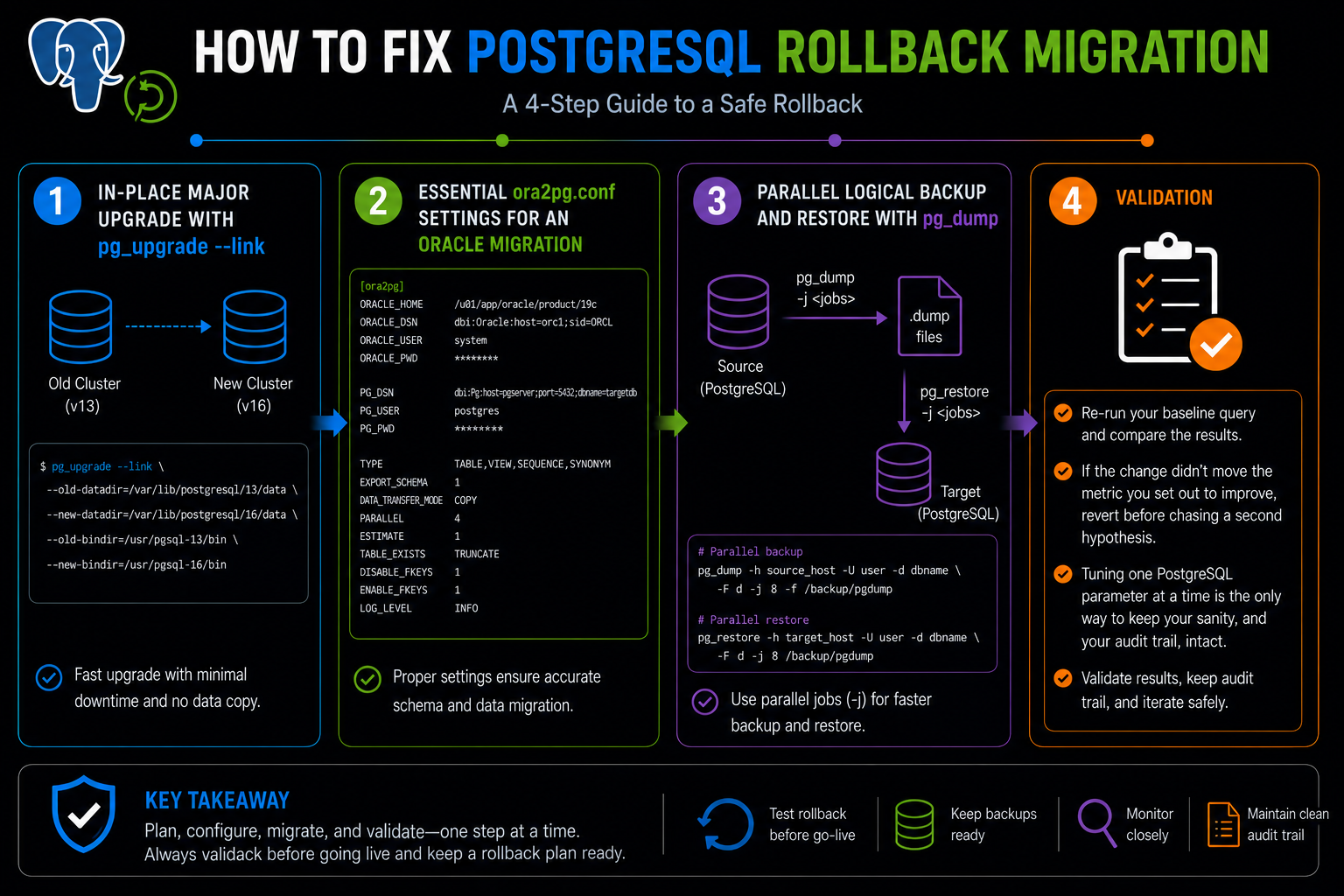
Step 1. In-place major upgrade with pg_upgrade --link.
pg_upgrade \
 --old-bindir=/usr/pgsql-15/bin \
 --new-bindir=/usr/pgsql-17/bin \
 --old-datadir=/var/lib/pgsql/15/data \
 --new-datadir=/var/lib/pgsql/17/data \
 --link --jobs 8./analyze_new_cluster.sh
Read the output with two questions in mind. Does the shape match what you expected? And what's the worst-case row? The shape tells you whether your mental model of the cluster matches reality. The worst-case row tells you where the next surprise will come from in your ora2pg conversion workflow.
How to fix postgresql rollback migration step by step
The fix breaks down into three layers: what to change, how to roll it out, and how to confirm it worked. Each layer has its own failure mode, and treating them as one step is the most common reason a fix gets reverted within the week.
On managed PostgreSQL services like AWS RDS, Aurora, Cloud SQL, and Azure Flexible Server, schema changes still happen via plain SQL. Configuration changes happen through parameter group rebuilds. Some parameters take effect immediately, others require a reboot. Verify with SELECT name, context FROM pg_settings WHERE name = '<param>'; before scheduling the change window.
Step 2. Essential ora2pg.conf settings for an Oracle migration.
ORACLE_DSN dbi:Oracle:host=oracle.local;sid=PRD;port=1521
ORACLE_USER system
ORACLE_PWD <Vault>
SCHEMA APP
TYPE TABLE,COPY,INDEXES,VIEW,GRANT,SEQUENCE,FUNCTION,PROCEDURE,PACKAGE,TRIGGER
DATA_LIMIT 10000
PARALLEL_TABLES 8
FILE_PER_INDEX 1
USE_TABLESPACE 0
PG_VERSION 17
Step 3. Parallel logical backup and restore with pg_dump.
pg_dump -h primary -U postgres -d appdb \
 -j 8 -Fd -f /backup/appdb_dir

pg_restore -h target -U postgres -d appdb_new -j 8 /backup/appdb_dir
Step 4. Validation. Re-run your baseline query and compare the results. If the change didn't move the metric you set out to improve, revert before chasing a second hypothesis. Tuning one PostgreSQL parameter at a time is the only way to keep your sanity, and your audit trail, intact.
Production guardrails and monitoring
The fix sticks only if the guardrails do. Add the alert before you forget, write the runbook entry while the diagnosis is fresh, and put a calendar reminder on your phone to revisit after the next major PostgreSQL upgrade.
- Add a Datadog or Prometheus alert on the metric you just improved at a threshold 20 percent above your new baseline.
- Capture an EXPLAIN (ANALYZE, BUFFERS) for any regressed query into your runbook so the on-call engineer has the next-step diagnostic ready.
- Document the rollback path: the exact SQL or ALTER SYSTEM sequence to restore the prior state if the change misbehaves.
- Set a calendar reminder to re-validate after the next major PostgreSQL version upgrade. Planner behaviors and default GUC values do change.
- Record the pg_stat_statements query ID and a representative plan in your team wiki so you can compare against future regressions in data migration.
- Schedule a follow-up review 30 days after the change to confirm the improvement persisted under realistic production traffic.
Common mistakes and anti-patterns
Below are the mistakes that show up consistently in PostgreSQL audits. Each one is fixable in an afternoon. Each one is also avoidable, if you know to look for it before it becomes load-bearing.
- Tuning postgresql rollback migration by copy-pasting from a 2014 blog post without re-validating against PostgreSQL 14, 15, 16, or 17 behavior.
- Changing more than one PostgreSQL parameter at a time without measurement.
- Forgetting to ANALYZE after a large data load, then wondering why the planner picked a sequential scan over your shiny new index.
- Trusting an unverified backup or untested failover for upgrade path.
- Treating autovacuum as something to disable rather than something to tune.
- Allowing developers to write production queries with no EXPLAIN review.
PostgreSQL on AWS, Aurora, GCP, Azure
If you're running on AWS RDS, Aurora, Cloud SQL, AlloyDB, or Azure Flexible Server, here's what changes. Schema work is identical to self-managed PostgreSQL. Configuration goes through parameter groups. Some OS-level levers are gone. And Aurora plays by slightly different rules because of its decoupled storage architecture.
Specifics worth memorizing. AWS RDS PostgreSQL on gp3 storage gives you provisioned IOPS, but the maximum is per-volume, not per-instance. That fact surprises customers scaling vCPU and expecting linear I/O. Google AlloyDB's columnar engine is opt-in per table; turning it on is a one-line SQL call, but the analytical workload eligibility rules aren't always obvious until you read the EXPLAIN plan. Azure Database for PostgreSQL Flexible Server exposes a broader set of extensions than RDS or Aurora, including pg_partman, pgvector, TimescaleDB, and Citus on the Citus-flavored variant.
When this approach is the wrong starting point
This technique assumes a roughly normal OLTP PostgreSQL workload with healthy autovacuum. It's the wrong starting point if your workload is dominated by long analytical queries against a Citus or TimescaleDB hypertable, if you run on Aurora's storage-decoupled architecture (where buffer-pool semantics differ), or if the symptom is actually a network or kernel-level issue masquerading as a PostgreSQL problem.
Another pattern we see often. An insurance carrier had been quoted 18 months and 2.4 million dollars to move off Oracle. We delivered the cutover in seven months at 60 percent lower cost using ora2pg, AWS DMS, and a strict zero-downtime cutover runbook with row-level checksum validation.
Frequently asked questions
How long does an Oracle to PostgreSQL migration take?
Schema and code conversion typically take 4 to 12 weeks for a mid-size enterprise schema. Application testing and cutover planning often take longer than the database work itself. End-to-end migrations of a year or more are not unusual.
Should Production teams use pg_upgrade or logical replication for major version upgrades?
pg_upgrade --link is right for short-window upgrades, with minutes of downtime. Logical replication enables true zero-downtime upgrades on critical workloads, at the cost of more orchestration and verification effort.
Is ora2pg good enough for stored procedure conversion?
ora2pg generates a strong first draft for tables, indexes, views, and most PL/SQL. Complex procedural code, packages with state, and Oracle-specific features still require manual review by an experienced PostgreSQL engineer.
What is the biggest mistake in a database migration project?
Skipping data validation. A migration that runs flawlessly but ships row-level differences is worse than one that fails noisily. Always verify with row counts, checksums, and sample diffs before cutting over.
How do I cut over to PostgreSQL with zero downtime?
Stand up logical replication from source to PostgreSQL, run dual writes for verification, switch reads first, then writes, and keep the source available as a rollback target for at least one business day after cutover.
Where should I start if I’m new to rollback strategy during postgresql migration?
Read this guide end to end, then run the diagnostic SQL queries against a non-production PostgreSQL database to build intuition. Most engineers we coach are productive within a day. Bookmark this page, then move on to the cluster posts linked below for deeper dives.
Further Reading
Data validation post-migration to PostgreSQL