MongoDB Compound Indexes Demystified: Building the Perfect Index Strategy
MongoDB’s compound indexes are among the most powerful tools for optimizing database performance, yet they remain one of the most misunderstood features. Compound indexes collect and sort data from multiple field values from each document in a collection, allowing you to query the first field or any prefix fields of the index. When implemented correctly, they can transform slow, resource-intensive queries into lightning-fast operations that scale with your application’s growth.
In this comprehensive guide, we’ll demystify compound indexes and provide you with a battle-tested strategy for building optimal index configurations that will supercharge your MongoDB performance.
Understanding Compound Indexes: The Foundation of Performance
If your application repeatedly runs a query that contains multiple fields, you can create a compound index to improve performance for that query. Unlike single-field indexes that optimize queries on one field, compound indexes create a sophisticated data structure that can efficiently handle complex queries involving multiple fields, sorting operations, and range conditions.
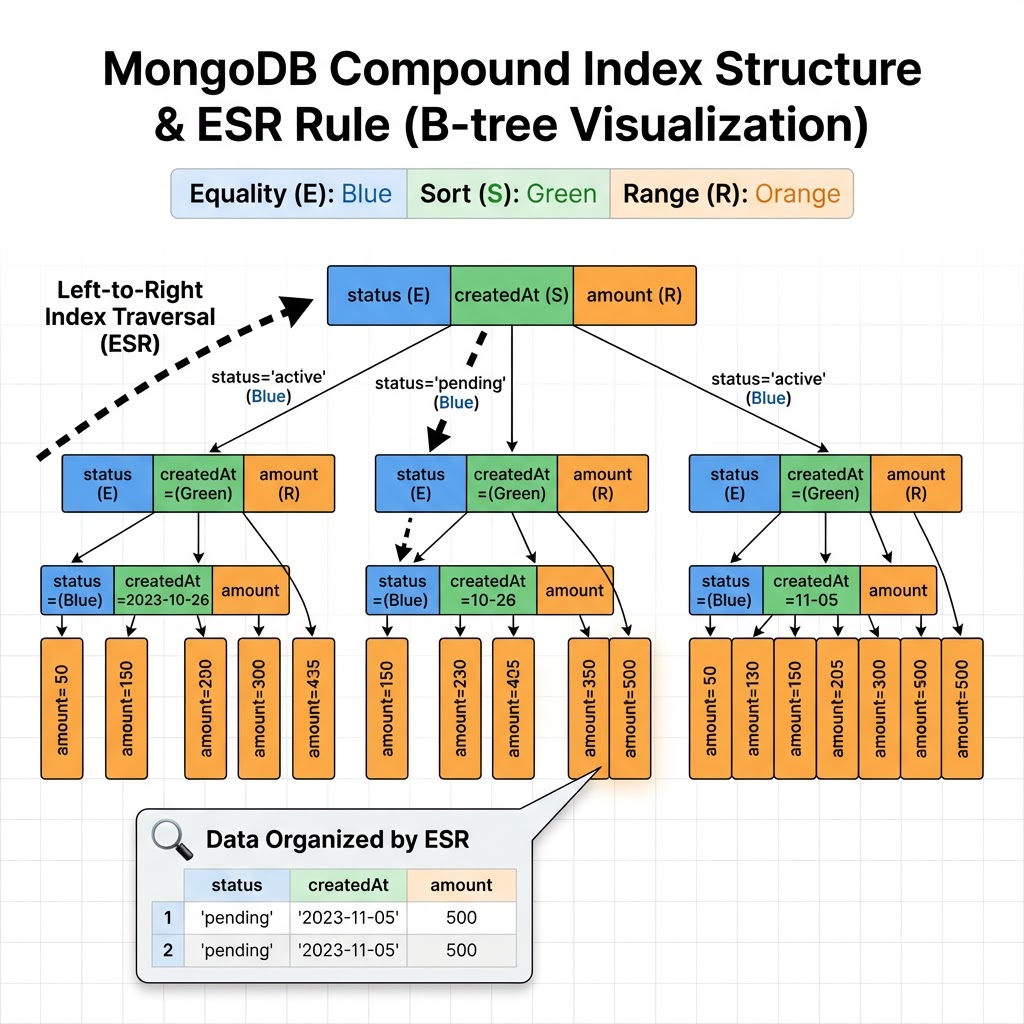
The magic of compound indexes lies in their B-tree structure, which organizes data hierarchically based on the order of fields specified in the index. This structure enables MongoDB to quickly navigate to the exact subset of documents that match your query criteria, dramatically reducing the amount of data that needs to be examined.
The ESR Rule: Your North Star for Index Design
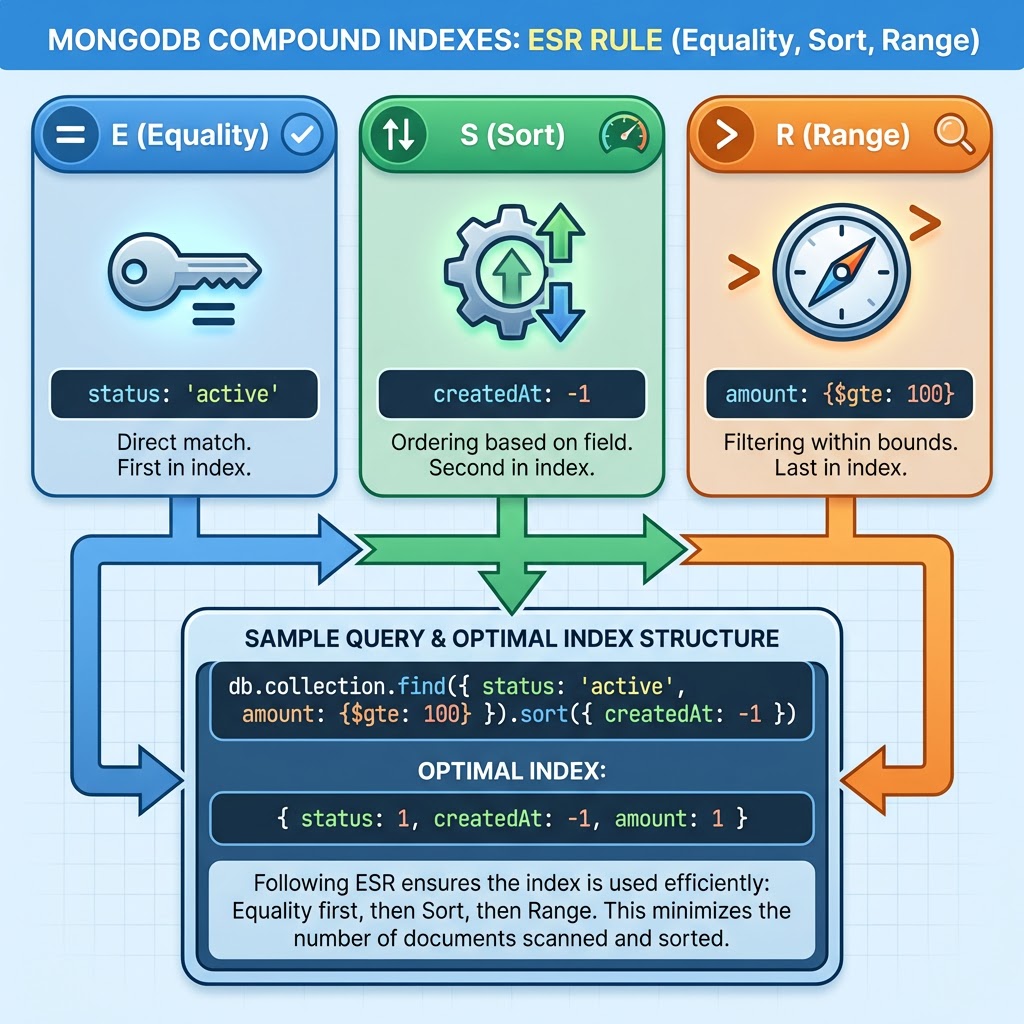
The order of the indexed fields impacts the effectiveness of a compound index. Compound indexes contain references to documents according to the order of the fields in the index. To create efficient compound indexes, follow the ESR (Equality, Sort, Range) guidelines.
The ESR Breakdown
The ESR rule is the most important principle for designing compound indexes. It defines the optimal order of fields in your index:
Equality (E): Fields with exact match conditions should come first. These fields immediately narrow down the search space, allowing MongoDB to quickly eliminate irrelevant documents.
Sort (S): Fields used in sort operations should come second. When positioned correctly, these fields allow MongoDB to return results in the desired order without performing expensive in-memory sorts.
Range (R): Fields with range conditions ($gt, $lt, $in, etc.) should come last. These create scans within the already-narrowed result set.
ESR in Action
Consider this real-world scenario:
// Query with equality, sort, and range conditions
db.orders.find({
status: "shipped", // Equality
amount: { $gte: 100 } // Range
}).sort({ createdAt: -1 }) // Sort

// ESR-optimized index
db.orders.createIndex({
status: 1, // E - Equality
createdAt: -1, // S - Sort
amount: 1 // R - Range
})
Leveraging Index Prefixes for Maximum Efficiency
Compound indexes have a powerful feature: they support multiple query patterns through index prefixes. A compound index supports queries on any prefix of its fields. This feature dramatically reduces the total number of indexes you need.
The Prefix Advantage
MongoDB traverses indexes from left to right. Equality fields narrow down the search space immediately. Sort fields allow MongoDB to return results in order without an in-memory sort. Range fields come last because they create a scan within the narrowed result set. However, the same index does NOT efficiently support queries that skip the prefix. Understanding this limitation is crucial for designing effective index strategies.
Performance Analysis: The Power of explain()
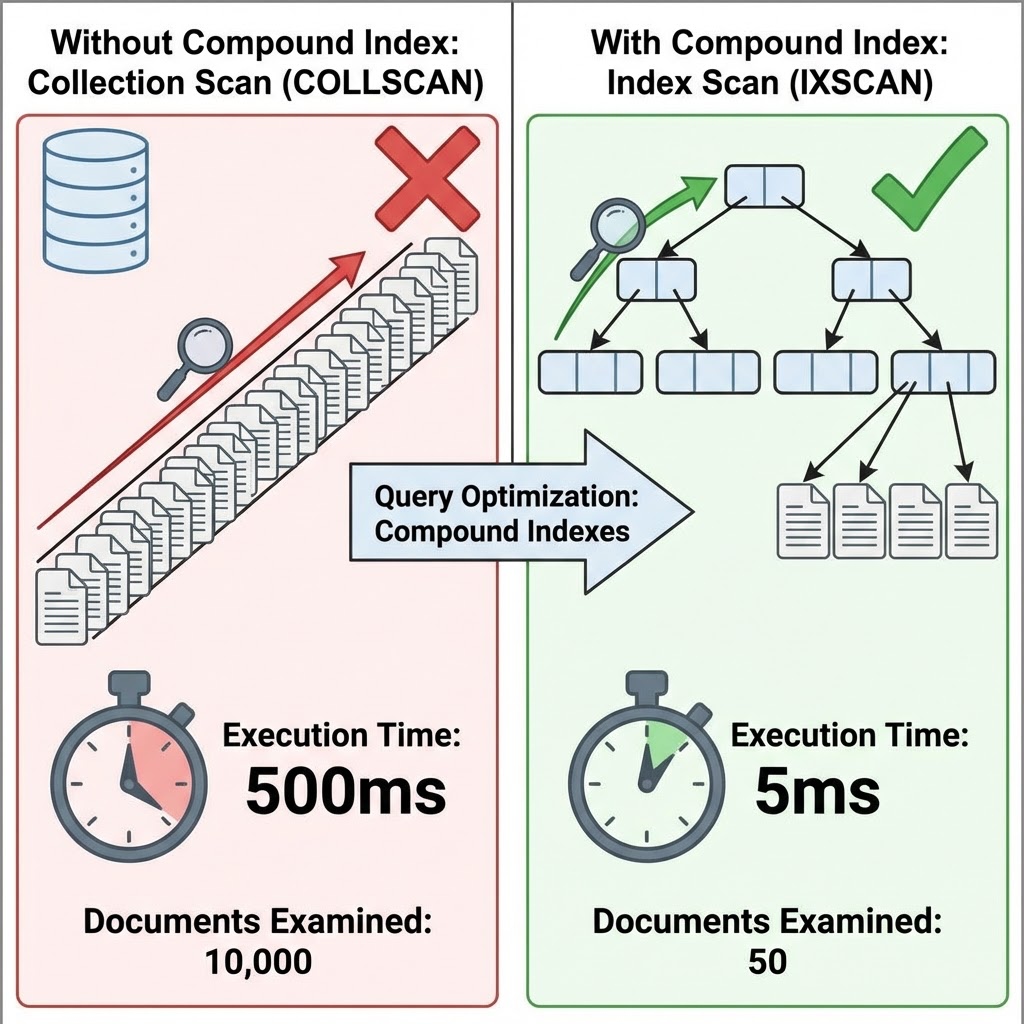
The explain() method is your primary tool for understanding how MongoDB uses your indexes. It provides detailed insights into query execution plans, helping you identify performance bottlenecks and optimization opportunities.
Key Metrics to Monitor
When analyzing explain() output, focus on these critical metrics:
| Metric | Good | Warning Sign |
|---|---|---|
| Stage | IXSCAN, FETCH | COLLSCAN |
| totalKeysExamined | Close to nReturned | >> nReturned |
| totalDocsExamined | 0 (covered query) or close to nReturned | >> nReturned |
| executionTimeMillis | Low (< 10ms for simple queries) | High (> 100ms) |
Identifying Performance Issues
Look for these warning signs in explain output: Collection scan (no index used), High ratio of examined to returned documents, In-memory sort, Index not fully utilized.
// Comprehensive performance analysis
const result = db.orders.find({
status: "shipped",
createdAt: { $gte: new Date("2025-01-01") }
}).sort({ amount: -1 }).explain("executionStats")

// Check for optimization opportunities
console.log("Index used:", result.queryPlanner.winningPlan.inputStage.indexName)
console.log("Keys examined:", result.executionStats.totalKeysExamined)
console.log("Docs examined:", result.executionStats.totalDocsExamined)
console.log("Execution time:", result.executionStats.executionTimeMillis, "ms")
Time-Series Data
For time-series queries, time field often comes after equality filters:
// Time-series optimization
db.metrics.createIndex({
    sensorId: 1,      // Filter by sensor
    metricType: 1,    // Filter by metric type
    timestamp: -1     // Sort by time (recent first)
})
E-commerce Product Catalogs
Support filtering, sorting, and pagination with strategic field ordering:
// E-commerce catalog index
db.products.createIndex({
    category: 1,  // Primary filter
    inStock: 1,   // Secondary filter
    rating: -1,   // Sort by rating
    price: 1      // Range filter on price
})
Common Pitfalls and How to Avoid Them
Mistake 1: Ignoring Query Patterns
Wrong: Creating index without analyzing actual queries. Right: Analyze your actual query patterns first. Always start with understanding your application’s query patterns before creating indexes.
Mistake 2: Index Proliferation
Wrong: Creating an index for every possible query. Right: Use prefix property strategically. Instead of creating multiple similar indexes, design compound indexes that can serve multiple query patterns through prefixes.
Mistake 3: Violating the ESR Rule
Wrong: Range field before sort field. Right: Follow ESR rule. Placing range fields before sort fields often results in expensive in-memory sorting operations.
Monitoring and Maintenance Strategies
Performance Advisor Integration
The Performance Advisor is a unique tool that automatically monitors MongoDB logs for slow-running queries and suggests indexes to improve query performance. The Performance Advisor monitors queries that MongoDB considers slow and suggests new indexes to improve query performance.
Key Monitoring Metrics
Learn how to monitor a MongoDB instance and which metrics you should consider to optimize performance:
- Index Hit Ratio: Percentage of queries using indexes vs. collection scans
- Index Size: Monitor memory usage to ensure indexes fit in RAM
- Query Performance: Track slow query logs and execution times
- Index Utilization: Identify unused or redundant indexes
Memory Considerations
As a rule of thumb we have: size of all indexes plus number of all active documents multiplied with the average document size. Ensure your working set (frequently accessed data and indexes) fits in available RAM for optimal performance.
Advanced Optimization Techniques
Sort Direction Strategy
The direction of fields in a compound index affects which sort operations the index can support. Plan your index directions carefully to support both ascending and descending sorts efficiently.
Covered Queries
Design indexes that can serve as covered queries, where all required data comes from the index itself, eliminating the need to fetch documents. The ratio can be less than 1 or even 0, indicating a covered query where the index contains all necessary data.
Index Intersection vs. Compound Indexes
While MongoDB can use multiple single-field indexes through intersection, compound indexes are generally more efficient for multi-field queries. Design compound indexes for your most common query patterns.
Building Your Index Strategy: A Systematic Approach
- Analyze Query Patterns: Use MongoDB’s profiler and slow query logs to understand your application’s query patterns.
- Apply the ESR Rule: Design indexes with Equality fields first, Sort fields second, and Range fields last.
- Leverage Prefixes: Create compound indexes that can serve multiple query patterns through prefix matching.
- Test with Production Data: Always test with: Realistic data volume, Realistic data distribution, Realistic query patterns.
- Monitor and Iterate: Use Performance Advisor and explain() to continuously optimize your index strategy.
Conclusion
Mastering MongoDB compound indexes is essential for building high-performance applications that scale. By following the ESR rule, leveraging index prefixes, and continuously monitoring performance, you can create an index strategy that transforms your database performance.
Remember that index optimization is an iterative process. Start with your most common query patterns, apply the principles outlined in this guide, and use MongoDB’s built-in tools to measure and refine your approach. With the right compound index strategy, you’ll unlock the full potential of your MongoDB deployment and deliver exceptional user experiences at any scale.
The key to success lies in understanding your data access patterns, applying proven optimization principles, and maintaining a disciplined approach to performance monitoring. Your users—and your infrastructure costs—will thank you for the investment in proper index design.
