Master Apache Kafka: Configuration, Performance Optimization, and Troubleshooting with MinervaDB
In today’s data-driven enterprise landscape, Apache Kafka has emerged as the backbone of real-time streaming architectures, powering mission-critical applications across industries. As organizations increasingly rely on event-driven systems and real-time analytics, the need for expert-level Kafka knowledge has never been more critical. MinervaDB, a leading provider of database consulting and managed services, offers comprehensive Kafka workshops designed to empower teams with the skills needed to configure, optimize, and troubleshoot Kafka deployments effectively.
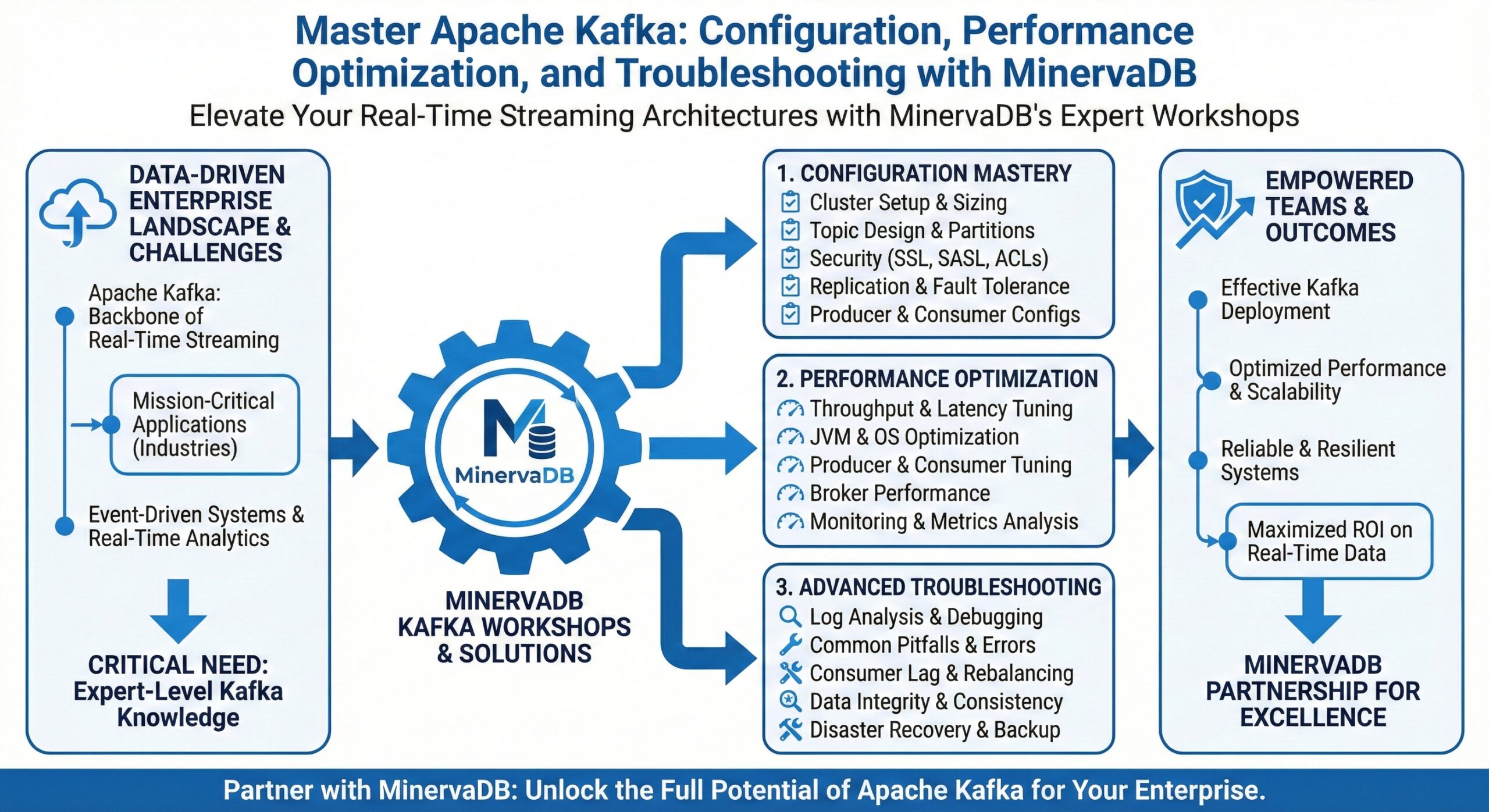
Understanding Apache Kafka’s Enterprise Significance
Apache Kafka is more than just a messaging system—it’s a distributed streaming platform that enables organizations to build real-time data pipelines and streaming applications. Used by over 80% of the Fortune 100 companies, Kafka has proven its value in handling high-throughput, low-latency data streaming scenarios. From financial services processing millions of transactions per second to e-commerce platforms managing real-time inventory updates, Kafka’s versatility makes it indispensable for modern enterprise architectures.
The complexity of Kafka deployments, however, requires specialized knowledge to unlock its full potential. Improper configuration can lead to performance bottlenecks, data loss, or system instability. This is where expert guidance becomes invaluable, and MinervaDB’s workshop approach addresses these challenges head-on.
Kafka Configuration Mastery
Broker Configuration Fundamentals
Effective Kafka performance begins with proper broker configuration. The broker serves as the heart of the Kafka cluster, and its configuration directly impacts throughput, latency, and reliability.
Critical Broker Parameters:
Parameter Purpose Optimization Impact
num.network.threads Controls network request handling Improves concurrent connection handling
num.io.threads Manages disk I/O operations Enhances disk throughput performance
log.segment.bytes Defines log segment size Affects storage efficiency and recovery time
socket.send.buffer.bytes Network send buffer size Optimizes network throughput
socket.receive.buffer.bytes Network receive buffer size Reduces network latency
The num.network.threads and num.io.threads settings require careful tuning based on hardware capabilities. Increasing these values can significantly enhance network and I/O operations, but over-provisioning can lead to resource contention.
Producer Configuration Optimization
Producer configuration plays a crucial role in determining message delivery semantics and performance characteristics. Key parameters include:
Essential Producer Settings:
- batch.size: Controls the maximum size of batched records. Larger batches improve throughput but increase latency
- linger.ms: Adds artificial delay to allow batching. Balances throughput vs. latency
- compression.type: Enables message compression (gzip, snappy, lz4, zstd) to reduce network bandwidth
- acks: Defines acknowledgment requirements (0, 1, all) affecting durability guarantees
- retries: Configures retry attempts for failed sends, ensuring message delivery reliability
Consumer Configuration Best Practices
Consumer configuration directly impacts processing efficiency and system stability. Critical parameters include:
Key Consumer Parameters:
Setting Function Performance Impact
fetch.min.bytes Minimum data per fetch request Reduces network overhead
fetch.max.wait.ms Maximum wait time for fetch requests Balances latency and efficiency
max.poll.records Records returned per poll Controls processing batch size
session.timeout.ms Consumer group session timeout Affects rebalancing frequency
heartbeat.interval.ms Heartbeat frequency Maintains group membership
Performance Optimization Strategies
Hardware and Infrastructure Optimization
Kafka performance is heavily dependent on underlying infrastructure. MinervaDB’s workshop emphasizes the importance of proper hardware selection and configuration:
Storage Optimization:
- Use SSDs for log directories to minimize I/O latency
- Implement RAID configurations for redundancy without sacrificing performance
- Separate log and metadata storage for optimal I/O distribution
Network Configuration:
- Configure high-bandwidth, low-latency network connections
- Optimize network buffer sizes at the OS level
- Implement network segmentation for Kafka traffic isolation
Memory Management:
- Allocate sufficient heap memory for JVM operations
- Configure page cache effectively for log segment caching
- Monitor garbage collection patterns and optimize JVM settings
Operating System Tuning
Operating system configuration significantly impacts Kafka performance:
File System Optimization:
- Use ext4 or XFS file systems for better performance
- Configure appropriate mount options (noatime, nobarrier)
- Optimize file descriptor limits for high-concurrency scenarios
Kernel Parameter Tuning:
- Adjust vm.swappiness to minimize swapping
- Configure vm.dirty_ratio and vm.dirty_background_ratio for write performance
- Optimize network stack parameters for high-throughput scenarios
Application-Level Performance Tuning
Beyond infrastructure, application-level optimizations can dramatically improve performance:
Throughput Optimization:
Throughput measures how many messages Kafka can process within a given timeframe. To maximize throughput:
- Increase batch sizes for both producers and consumers
- Optimize partition count based on parallelism requirements
- Implement compression to reduce network and storage overhead
- Use asynchronous processing patterns where possible
Latency Reduction:
Low latency enables near-real-time data processing and analysis. Latency optimization strategies include:
- Minimize linger.ms for time-sensitive applications
- Reduce fetch.max.wait.ms for faster consumer response
- Optimize network configurations to reduce transmission delays
- Implement proper partition strategies to avoid hot spots
Comprehensive Troubleshooting Methodologies
Common Kafka Issues and Solutions
MinervaDB’s workshop covers the most frequently encountered Kafka problems and their resolution strategies:
Consumer Lag Issues:
Consumer lag occurs when consumers cannot keep pace with message production. Common causes and solutions include:
- Processing Logic Optimization: Streamline consumer processing logic
- Partition Count Modifications: Increase partitions to enable more parallel processing
- Rate Limiting: Implement backpressure mechanisms to prevent overwhelming consumers
- Configuration Tuning: Adjust max.poll.records and fetch.max.bytes for optimal batch processing
Broker Overload Scenarios:
When brokers become overwhelmed, several symptoms may appear:
- High CPU utilization
- Increased response times
- Network saturation
- Disk I/O bottlenecks
Resolution strategies include:
- Scaling out by adding more brokers to the cluster
- Rebalancing partition leadership across brokers
- Optimizing producer batch sizes and compression
- Implementing proper monitoring and alerting
Network and Connectivity Issues:
Network problems can manifest as:
- Connection timeouts
- Intermittent message delivery failures
- Replication lag between brokers
Diagnostic approaches:
- Monitor socket buffer utilization
- Analyze network packet loss and latency
- Verify firewall and security group configurations
- Test inter-broker connectivity and bandwidth
Diagnostic Tools and Techniques
Effective troubleshooting requires the right tools and methodologies:
Built-in Kafka Tools:
- kafka-producer-perf-test.sh: Performance testing for producers
- kafka-consumer-perf-test.sh: Consumer performance validation
- kafka-log-dirs.sh: Log directory analysis and health checks
- kafka-topics.sh: Topic configuration and metadata inspection
Third-party Monitoring Solutions:
- Open-Messaging-Benchmark for comprehensive performance testing
- Confluent’s kafka-load-gen for load testing scenarios
- LinkedIn’s kafka-tools for advanced diagnostics
MinervaDB’s Workshop Approach
Expert-Led Training Methodology
MinervaDB’s Kafka workshops combine theoretical knowledge with hands-on practical experience. As a vendor-neutral consulting firm with expertise across multiple database technologies, MinervaDB brings a unique perspective to Kafka training.
Workshop Structure:
- Foundational Concepts: Understanding Kafka architecture and core principles
- Configuration Deep-Dive: Hands-on configuration of brokers, producers, and consumers
- Performance Lab: Real-world performance tuning exercises
- Troubleshooting Scenarios: Simulated problem-solving sessions
- Best Practices Review: Industry-proven deployment strategies
Tailored Learning Experience
MinervaDB’s consultative approach ensures that workshop content aligns with specific organizational needs:
- Industry-Specific Use Cases: Customized scenarios relevant to participants’ domains
- Architecture Review: Analysis of existing Kafka deployments
- Performance Benchmarking: Establishing baseline metrics and improvement targets
- Ongoing Support: Post-workshop consultation and support services
Monitoring and Maintenance Excellence
JMX Metrics and Monitoring
Effective Kafka operations require comprehensive monitoring strategies. Java Management Extensions (JMX) provide detailed insights into Kafka performance:
Critical Metrics to Monitor:
| Metric Category | Key Indicators | Monitoring Purpose |
|---|---|---|
| Broker Metrics | Request rate, error rate, network utilization | Overall cluster health |
| Producer Metrics | Send rate, batch size, compression ratio | Producer performance |
| Consumer Metrics | Lag, fetch rate, processing time | Consumer efficiency |
| Topic Metrics | Partition count, replication factor, size | Resource utilization |
Monitoring Tools Integration:
- JConsole for real-time JMX metric browsing
- Prometheus and Grafana for time-series monitoring
- Confluent Control Center for comprehensive cluster management
- Custom dashboards for business-specific KPIs
Proactive Maintenance Strategies
MinervaDB emphasizes proactive maintenance to prevent issues before they impact production systems:
Regular Maintenance Tasks:
- Log retention policy reviews and adjustments
- Partition rebalancing for optimal distribution
- Security updates and patch management
- Capacity planning and scaling assessments
- Backup and disaster recovery testing
Enterprise Integration Patterns
Multi-Datacenter Replication
Enterprise deployments often require data replication across multiple datacenters for disaster recovery and geographic distribution:
Replication Strategies:
- Active-passive configurations for disaster recovery
- Active-active setups for global data distribution
- Hub-and-spoke patterns for centralized data aggregation
- Mesh topologies for complex multi-region scenarios
Security and Compliance
Production Kafka deployments must address security and compliance requirements:
Security Best Practices:
- SSL/TLS encryption for data in transit
- SASL authentication for client access control
- ACL-based authorization for fine-grained permissions
- Network segmentation and firewall configurations
- Audit logging for compliance requirements
Conclusion: Accelerating Kafka Success with MinervaDB
Apache Kafka’s power lies not just in its technical capabilities, but in how effectively organizations can harness those capabilities. Proper configuration, performance optimization, and troubleshooting expertise are essential for realizing Kafka’s full potential in enterprise environments.
MinervaDB’s comprehensive Kafka workshops provide the knowledge and practical skills needed to excel in today’s streaming-first world. With deep expertise in database technologies and a proven track record of helping organizations optimize their data infrastructure, MinervaDB stands ready to accelerate your Kafka journey.
Whether you’re planning a new Kafka deployment, optimizing existing clusters, or building team capabilities, MinervaDB’s expert-led workshops offer the guidance and support needed for success. The combination of theoretical knowledge, hands-on experience, and ongoing consultative support ensures that your investment in Kafka training delivers measurable business value.
Ready to optimize your Kafka deployment? Contact MinervaDB today to learn more about our comprehensive Kafka workshops and consulting services. Let our experts help you unlock the full potential of your streaming data architecture.
MinervaDB provides vendor-neutral consulting, support, and managed services for a wide range of database technologies, including specialized expertise in Apache Kafka configuration, performance optimization, and troubleshooting. Our team of certified professionals brings years of hands-on experience across diverse industries, ensuring that your Kafka implementation meets the highest standards of performance, reliability, and scalability.