MinervaDB Emergency Database Support Services
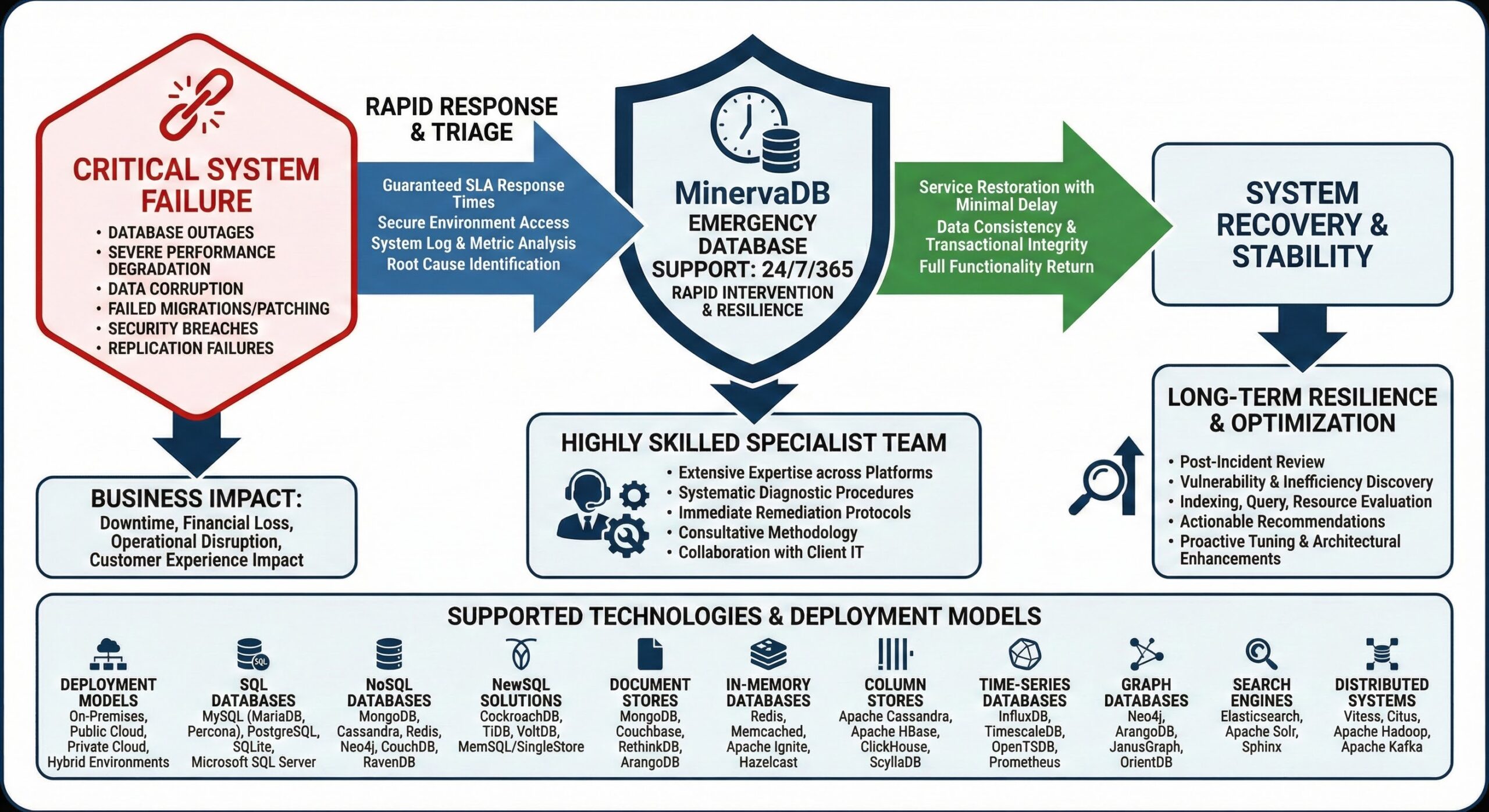
When a critical database system fails, the consequences can be immediate and severe, disrupting operations, impacting customer experience, and incurring significant financial losses. In such high-pressure scenarios, rapid intervention is not only advantageous—it is essential. MinervaDB offers comprehensive, around-the-clock emergency support specifically designed to restore database environments swiftly and efficiently, minimizing downtime and ensuring business continuity.
At the core of MinervaDB’s emergency response capability is a team of highly skilled database professionals with extensive expertise across a broad spectrum of database platforms and architectures, including relational databases like PostgreSQL, MySQL, MariaDB, and Oracle MySQL HeatWave; cloud-native solutions such as Amazon RDS, Amazon Aurora, Azure SQL, and Google Cloud SQL; analytical and data warehousing systems including Amazon Redshift, Snowflake, Google BigQuery, and ClickHouse; distributed databases like Cassandra and MongoDB; in-memory data stores such as Redis and Valkey; query engines like Trino; and vector databases including Milvus. These specialists are trained to respond promptly to critical incidents, utilizing systematic diagnostic procedures to identify root causes of failures. Whether the issue arises from configuration errors, hardware malfunctions, software defects, or sudden workload surges, the team implements immediate remediation protocols to stabilize the system and restore service with minimal delay.
The recovery process begins with rapid triage and assessment. Upon engagement, MinervaDB’s experts establish secure access to the affected environment and conduct a thorough analysis of system logs, performance metrics, and error reports. This enables precise identification of the failure point, facilitating targeted corrective actions across diverse technologies—from transactional anomalies in PostgreSQL to replication lag in MongoDB or query bottlenecks in Databricks. The objective extends beyond simply restoring operations; it ensures systems return to full functionality with data consistency and transactional integrity maintained.
Beyond immediate recovery, MinervaDB emphasizes long-term system resilience. The support team performs a post-incident review to uncover underlying vulnerabilities or inefficiencies that may have contributed to the outage. This includes evaluating indexing strategies, query performance, resource allocation, and backup reliability across platforms such as Redis clusters, Cassandra rings, or Snowflake warehouses. Based on these findings, actionable recommendations are delivered to enhance system stability and prevent recurrence of similar issues.
MinervaDB’s emergency support framework is built on a foundation of comprehensive service features tailored to modern enterprise needs. Support is available 24 hours a day, 7 days a week, 365 days a year, ensuring assistance is accessible at any time, regardless of time zone or business cycle. Service Level Agreements (SLAs) are structured to guarantee rapid response times for critical incidents, aligning with the urgency typical of production outages.
Clients benefit from multiple support channels, including direct phone access and real-time chat, enabling seamless coordination during high-stress events. This multi-channel approach allows technical teams to initiate support requests through the most efficient means, reducing delays in escalation and response.
Support coverage spans all deployment models—on-premises data centers, public and private cloud infrastructures, and hybrid environments. This flexibility ensures organizations receive consistent, expert-level assistance regardless of their technology stack or hosting configuration, whether running self-managed PostgreSQL instances or fully managed DBaaS platforms like Databricks or Azure SQL. Each engagement is handled with the highest level of confidentiality and operational sensitivity, adhering to strict data protection and compliance standards.
A key differentiator of MinervaDB’s service is its consultative methodology. Rather than applying temporary fixes, the team collaborates closely with client IT personnel to understand the unique characteristics of their database ecosystem. This enables the development of customized solutions aligned with specific business requirements, application workloads, and performance goals across diverse technologies. Additionally, clients gain access to an extensive repository of technical knowledge, best practices, and optimization techniques refined through years of resolving complex database challenges involving systems like Trino query engines, Milvus vector databases, and high-throughput Redis/Valkey caches.
The benefits of engaging MinervaDB for emergency support are significant. Most critically, downtime is minimized, reducing the operational and financial impact of outages. Organizations gain confidence knowing that expert assistance is available on demand, enabling faster resolution of even the most complex recovery scenarios across heterogeneous environments. Over time, systems become more resilient through proactive tuning and architectural enhancements, resulting in improved reliability and performance.
Common emergencies addressed by the team include complete database outages, severe performance degradation, data corruption, failed migrations or patching processes, security breaches, and replication failures between primary and standby systems—across platforms ranging from traditional RDBMS like MySQL and MariaDB to modern cloud data platforms such as Snowflake, BigQuery, and Databricks. Each scenario is managed with a methodical, evidence-based approach to ensure data integrity and service restoration.
Technology Focus
| Category | Technology | Enterprise Ready | 24/7 Support |
|---|---|---|---|
| SQL Databases | PostgreSQL | ✓ | ✓ |
| MySQL | ✓ | ✓ | |
| MariaDB | ✓ | ✓ | |
| SQL Server | ✓ | ✓ | |
| SAP HANA | ✓ | ✓ | |
| NoSQL Document | MongoDB | ✓ | ✓ |
| CouchDB | ✓ | ✓ | |
| NoSQL Key-Value | Redis | ✓ | ✓ |
| Valkey | ✓ | ✓ | |
| NoSQL Wide-Column | Cassandra | ✓ | ✓ |
| HBase | ✓ | ✓ | |
| NoSQL Graph | Neo4j | ✓ | ✓ |
| Analytics | ClickHouse | ✓ | ✓ |
| Trino | ✓ | ✓ | |
| Vertica | ✓ | ✓ | |
| GreenPlum | ✓ | ✓ | |
| NewSQL | CockroachDB | ✓ | ✓ |
| TiDB | ✓ | ✓ | |
| Vector Databases | Milvus | ✓ | ✓ |
| Pinecone | ✓ | ✓ | |
| Cloud Platforms | AWS RDS | ✓ | ✓ |
| Azure SQL | ✓ | ✓ | |
| Google Cloud SQL | ✓ | ✓ | |
| Google AlloyDB | ✓ | ✓ | |
| Amazon Aurora | ✓ | ✓ | |
| Snowflake | ✓ | ✓ | |
| Databricks | ✓ | ✓ | |
| BigQuery | ✓ | ✓ | |
| Redshift | ✓ | ✓ | |
| MySQL HeatWave | ✓ | ✓ |

Further Reading
- CockroachDB Support
- Cassandra Support
- Configuring PostgreSQL Logs for Query Performance Troubleshooting
- Creating High Availability with PostgreSQL 14 Stream Replication: A Step-by-Step Guide
- How to engage MinervaDB for MySQL DBA Support
- Data Engineering and Analytics in Banking and FinTech
- Data Engineering and Analytics in Digital Payment Solutions
- Data Architecture, Engineering, and Operations for Digital Advertising Networks: A MinervaDB Perspective
- Data Strategy and Analytics
- Vector Data Engineering