Data Analyst Hiring Strategies for 2026: Attracting Top Talent in a Competitive Market
The demand for skilled data analysts continues to surge as organizations increasingly rely on data-driven decision-making. With the average data analyst salary reaching $111,000 in 2025, companies are investing heavily in securing top talent 1. As we move through 2026, effective hiring strategies must evolve to meet the challenges of a competitive job market and rapidly changing technological landscape. This guide outlines proven, data-informed approaches to attract, assess, and onboard high-performing data analysts.
What Is Data-Driven Hiring and Why It Matters
Data-driven hiring is a recruitment strategy that uses measurable insights from data—rather than intuition—to make informed, objective hiring decisions 4. This approach eliminates guesswork and reduces bias by relying on performance metrics, candidate assessments, and historical hiring data 2. For data analyst roles specifically, this method ensures that hiring managers evaluate candidates based on actual analytical capabilities rather than subjective impressions.
Organizations leveraging data-driven recruitment track key metrics such as time-to-hire, cost-per-hire, candidate quality, and retention rates 2. These insights enable continuous improvement of the hiring process, ensuring better alignment between candidate profiles and role requirements.
Essential Skills and Qualifications for Modern Data Analysts
While technical proficiency in SQL, Python, and data visualization tools like Tableau or Power BI remains fundamental, employers are now placing greater emphasis on domain-specific knowledge and soft skills. According to industry trends, successful data analysts in 2026 possess:
- Advanced analytical reasoning: Ability to translate complex datasets into actionable business insights
- AI and machine learning familiarity: Understanding of how AI models work, even if not building them directly
- Business acumen: Knowledge of key performance indicators (KPIs) relevant to the industry
- Communication skills: Capacity to present findings clearly to non-technical stakeholders
Moreover, companies are increasingly seeking candidates with experience in cloud platforms (e.g., AWS, Google Cloud) and real-time data processing systems 3. Upskilling in artificial intelligence-related tools has become a differentiator in the hiring process, with significant implications for ramp-up time and productivity 1.
Optimizing Recruitment with Applicant Tracking Systems (ATS)
A well-configured Applicant Tracking System (ATS) is critical for managing high volumes of applications efficiently. In 2026, leading organizations are mastering their ATS by:
- Conducting regular audits of system settings and workflows
- Improving resume parsing accuracy for technical roles
- Automating initial screening with predefined skill filters
- Integrating AI-powered job matching algorithms
Configuring workflows around actual hiring realities—not idealized processes—ensures smoother coordination between HR, hiring managers, and technical teams 5. Automation frees recruiters to focus on relationship-building and candidate engagement rather than administrative tasks.
Leveraging People Analytics and Diversity Metrics
People analytics plays a pivotal role in shaping equitable and effective hiring strategies 8. HR teams are now using data to monitor diversity across the hiring funnel, identifying bottlenecks and implementing corrective actions. Key diversity hiring metrics for 2026 include:
- Sourcing channel diversity: Where underrepresented candidates originate
- Interview-to-offer ratio by demographic group: Identifying potential bias in evaluation
- Retention rates by cohort: Measuring long-term inclusion success
By applying the same analytical rigor used in business intelligence to recruitment, organizations can build more inclusive teams while improving overall talent quality 6.
Reducing Ramp-Up Time and Enhancing Onboarding
One of the biggest challenges in hiring data analysts is the lengthy onboarding period—often stretching up to six months 1. To accelerate productivity, companies are adopting strategies such as:
- Pre-onboarding skill assessments: Identifying knowledge gaps before day one
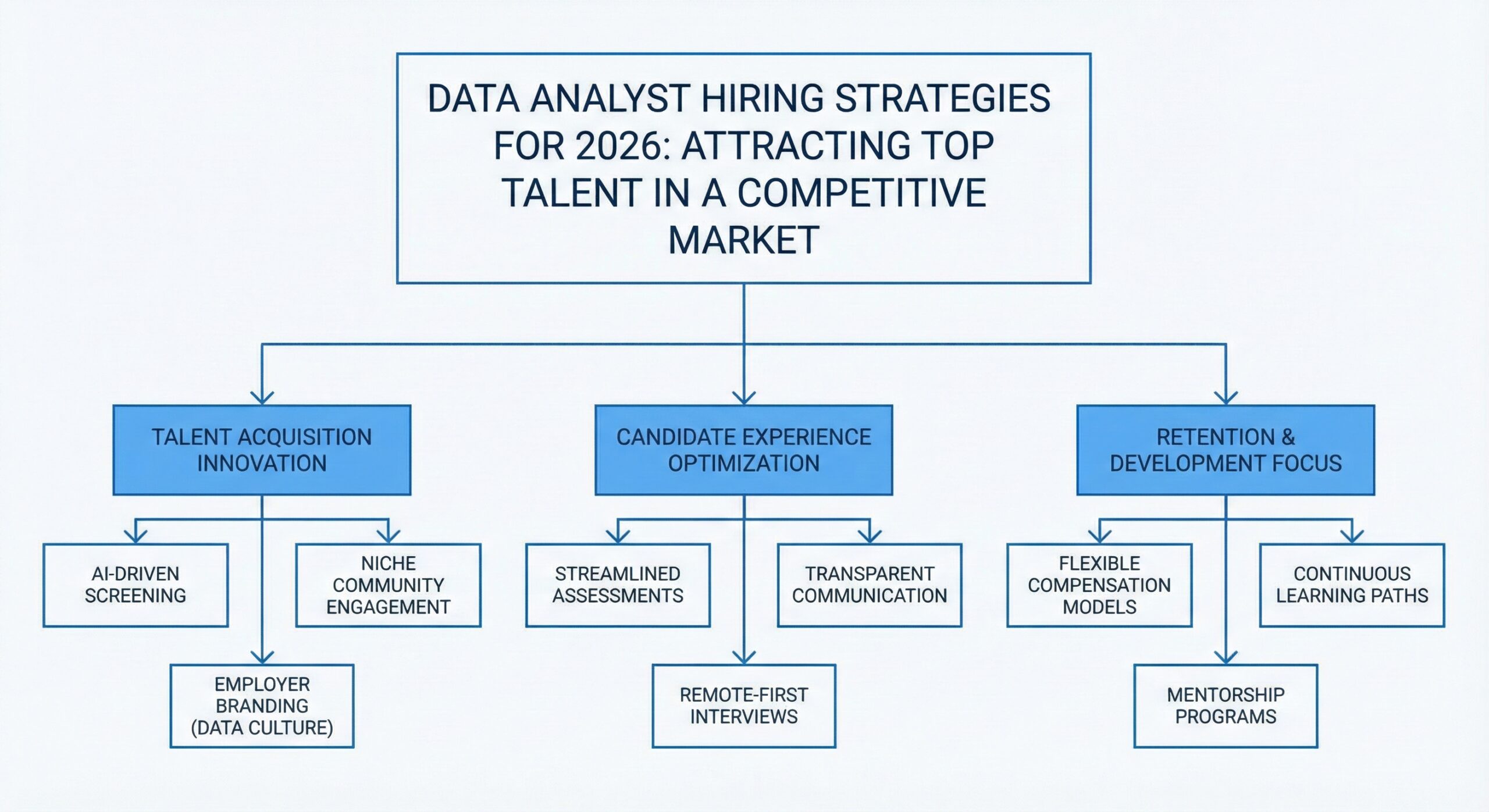
- Structured onboarding programs: Pairing new hires with mentors and providing curated learning paths
- Access to sandbox environments: Allowing analysts to explore real datasets safely during training
Investing in AI-enhanced training platforms can further reduce ramp-up time by personalizing learning experiences based on individual strengths and weaknesses 1.
Recruitment Best Practices Shaping 2026
Beyond technical considerations, broader recruitment best practices are influencing how companies hire data analysts 9. These include:
- Employer branding: Showcasing data-driven culture and impact through case studies and employee testimonials
- Candidate experience optimization: Ensuring timely communication and feedback throughout the hiring journey
- Proactive talent pipelining: Building relationships with potential candidates before roles open
Recruiters are also focusing on long-term workforce planning, anticipating future skill needs and aligning hiring strategies accordingly 7.
Conclusion: Building a Future-Ready Data Team
Hiring data analysts in 2026 requires a strategic, analytics-informed approach. By embracing data-driven recruitment, optimizing ATS usage, prioritizing both technical and soft skills, and fostering diversity through measurable goals, organizations can secure top-tier talent efficiently 24. Additionally, reducing onboarding time through structured programs enhances return on investment in new hires 1.
As data continues to drive business transformation, the ability to hire and integrate skilled analysts will remain a key competitive advantage. Companies that adopt these forward-looking hiring strategies will be best positioned to thrive in an increasingly data-centric world 3.
References
[^1]: [Data Analyst Hiring Guide 2026: How to Cut Ramp-Up Time from 6 Months …](https://www.ccslearningacademy.com/data-analyst-hiring-guide/) (31%)
[^2]: [Data-Driven Recruitment: The Benefits and 5 Best Practices – AIHR](https://www.aihr.com/blog/data-driven-recruitment/) (18%)
[^3]: [Data and analytics hiring in strong demand heading into 2026](https://www.spiceworks.com/it-careers/data-and-analytics-hiring-in-strong-demand-heading-into-2026/) (17%)
[^4]: [Data Driven Hiring: An Effective 2026 Recruitment Strategy](https://www.assesscandidates.com/data-driven-hiring/) (9%)
[^5]: [Mastering Your Applicant Tracking System in 2026](https://power.atsondemand.com/mastering-your-applicant-tracking-system-in-2026-a-complete-guide/) (6%)
[^6]: [Data-Driven Diversity Hiring: 12 Metrics Every HR Leader …](https://www.nationalsearchgroup.com/data-driven-diversity-hiring/) (6%)
[^7]: [2026 Hiring Trends: What Recruiters and Employers Need to Know](https://www.bainandgray.com/blog/2026-hiring-trends-what-recruiters-and-employers-need-to-know) (5%)
[^8]: [Recruitment Best Practices Shaping 2026](https://recruiterflow.com/blog/recruitment-best-practices/) (4%)